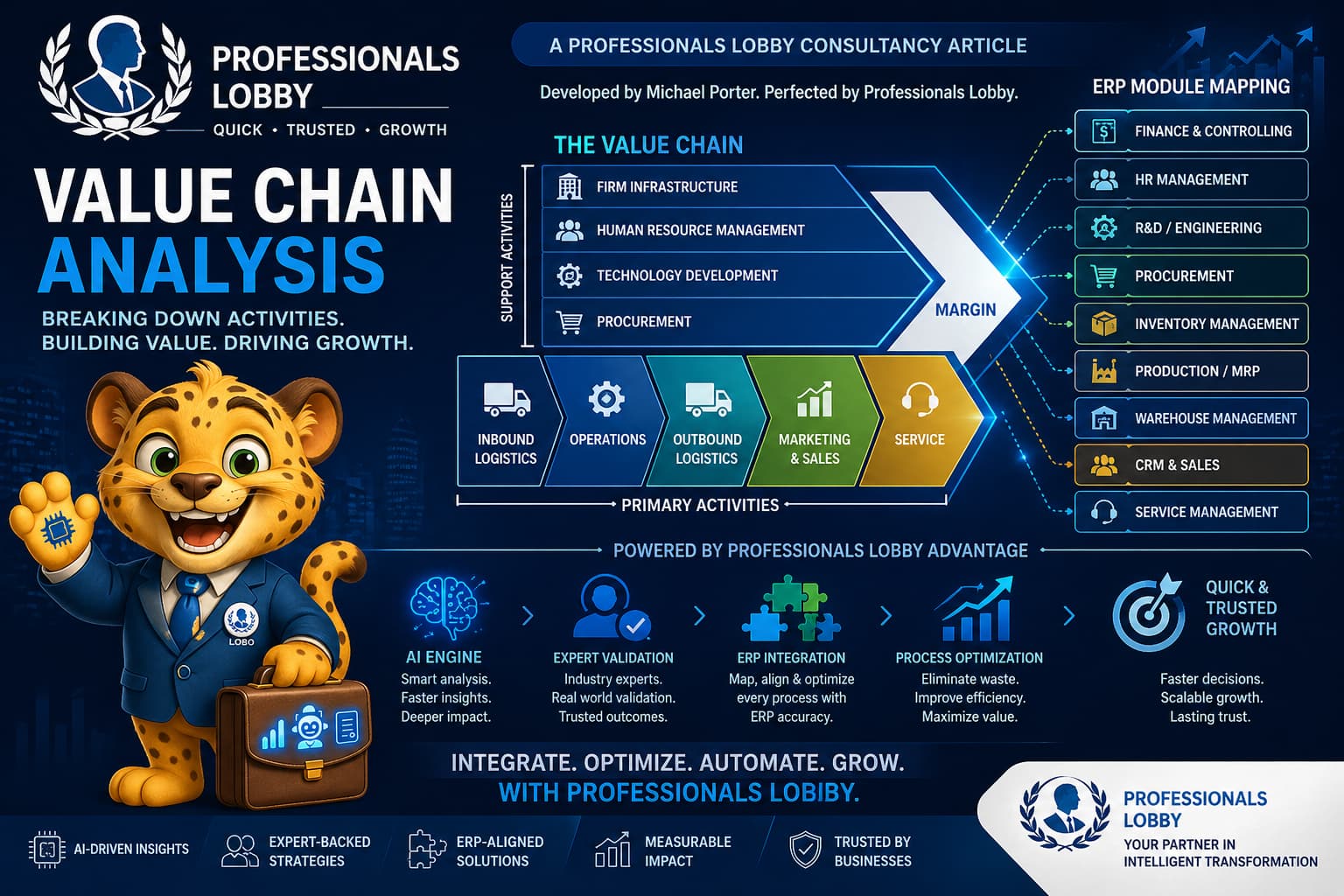
In modern consulting, organizations don't compete merely on products—they compete on how efficiently and intelligently they create value. Value Chain Analysis, introduced by Michael Porter, is a foundational framework that dissects a business into its core activities to identify where value is created, where inefficiencies exist, and where competitive advantage can be built.
At Professionals Lobby, we extend this classical model into a next-generation consulting tool by integrating AI-driven diagnostics, ERP mapping intelligence, expert validation layers, and rapid execution strategies.
From Process Mapping to Intelligent Value Engineering.
What is Value Chain Analysis?
Value Chain Analysis breaks an organization into Primary Activities and Support Activities, each contributing to the overall value delivered to customers.
Primary Activities
Support Activities
Primary Activities (Direct Value Creation)
Inbound Logistics
Receiving, storing, and managing inputs — sourcing, warehousing, inventory control
Operations
Transforming inputs into products/services — production, assembly, quality control
Outbound Logistics
Distribution to customers — order processing, delivery, transportation
Marketing & Sales
Demand generation and conversion — advertising, pricing, channel management
Service
After-sales support and customer retention — installation, repairs, training
Support Activities (Enabling Efficiency)
Procurement
Supplier sourcing and purchasing — vendor management, contract negotiation
Technology Development
Innovation, IT, automation — R&D, process automation, digital tools
HR Management
Talent and capability building — recruitment, training, compensation
Firm Infrastructure
Finance, governance, compliance — legal, accounting, quality management
Why Value Chain Analysis Matters Today
Professionals Lobby Perspective: Value Chain 2.0
We don't just map processes—we intelligently re-engineer them.
AI-Driven Value Chain Diagnostics
AI scans business workflows, identifies bottlenecks, suggests automation, and predicts value leakage points.
ERP Module Mapping
Bridges strategy + systems seamlessly by mapping each value chain activity to ERP modules.
Expert Validation Layer
Domain experts validate AI insights, apply industry benchmarks, assess risk and ROI.
Rapid Transformation Model
Faster diagnosis, faster recommendations, faster implementation alignment.
ERP Module Mapping (Critical Differentiator)
Value Chain Analysis becomes extremely powerful when linked to ERP systems:
| Value Chain Activity | ERP Modules |
|---|---|
| Inbound Logistics | Inventory Management, Procurement, Supplier Portal |
| Operations | Production, Manufacturing (MRP), Quality Control |
| Outbound Logistics | Warehouse Management (WMS), Distribution, Shipping |
| Marketing & Sales | CRM, Sales Management, Pricing Engine |
| Service | Service Management, Warranty, Helpdesk |
| Support Functions | HR, Payroll, Finance, Accounting, IT Management |
👉 This is where Professionals Lobby dominates—bridging strategy + systems seamlessly.
Step-by-Step Methodology (Professionals Lobby Model)
Example: Value Chain in a Trading Company
Key Benefits
Common Mistakes to Avoid
Value Chain vs Other Frameworks
👉 It acts as the bridge between strategy and execution
Conclusion: From Process Mapping to Intelligent Value Engineering
Value Chain Analysis is no longer just a consulting framework—it is a strategic engine for transformation.
With Professionals Lobby's AI-driven and expert-validated approach, organizations can:
- Move faster
- Operate smarter
- Scale confidently
"An intelligent system for continuously optimizing how businesses create, deliver, and scale value."
Our Consultancy Ecosystem
Applying Value Chain Analysis across specialized consulting domains
ERP & Digital Transformation
ERP module mapping & optimization
AI Consultancy
AI-driven value chain diagnostics
IT Consultancy
Technology infrastructure alignment
Strategy Consulting
Competitive advantage creation
Tax Consultancy
Compliance process optimization
Legal Consulting
Governance and compliance
Accounting Services
Financial process optimization
Education Consulting
Institutional process mapping
Property Consulting
Real estate value chain analysis