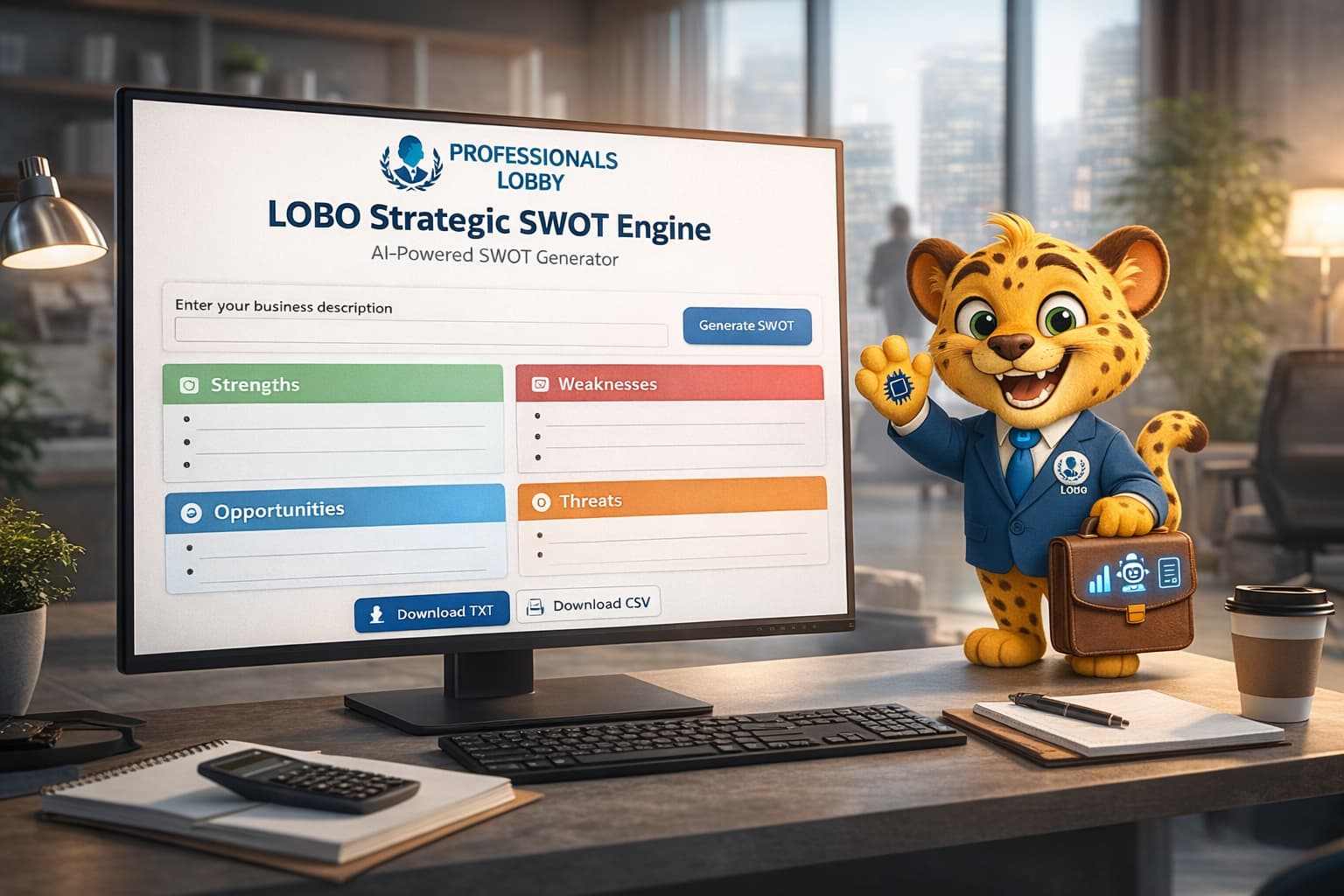
In consulting, clarity beats complexity. Among all frameworks—from MECE to Rule of 3 and the 7 C's—SWOT Analysis remains one of the most enduring and practical tools for structured thinking. It distills strategy into four simple yet powerful quadrants: Strengths, Weaknesses, Opportunities, and Threats.
Despite its simplicity, SWOT is powerful when used rigorously — especially in market entry, ERP selection, and digital transformation planning.
What Makes SWOT Still Relevant in 2026?
SWOT persists because it satisfies three consulting imperatives:
Structured Thinking (MECE-Compatible)
Internal vs External | Positive vs Negative — naturally aligned with Mutually Exclusive, Collectively Exhaustive logic.
Rapid Executive Communication
Compresses complex analysis into a single-page strategic snapshot for board discussions and CXO briefings.
Versatility Across Domains
Unlike niche frameworks, SWOT applies across strategy, technology, operations, and market positioning.
Breaking Down the SWOT Quadrants
Strengths (S)
Internal PositiveYour competitive advantages — what you do better than others.
Examples:
- Strong brand recognition in UAE market
- Established ERP implementation team
- Proprietary datasets and AI capabilities
- Financial stability for scaling
Consultant Insight: Strengths should be evidence-backed, not aspirational. Avoid vague claims like "good service."
Weaknesses (W)
Internal NegativeInternal constraints limiting performance.
Examples:
- Limited AI capability vs competitors
- Dependence on manual processes
- Weak integration between systems
- Lack of industry-specific ERP expertise
Consultant Insight: Weaknesses should be framed as actionable gaps, not excuses.
Opportunities (O)
External PositiveMarket dynamics and trends that create upside.
Examples:
- UAE government push for digital transformation
- Growing demand for ERP in SMEs
- AI-driven automation adoption
- Industry-specific ERP niches
Consultant Insight: Opportunities should be time-bound and realistic, not generic trends.
Threats (T)
External NegativeExternal risks that could impact performance.
Examples:
- Intense ERP vendor competition
- Rapid tech obsolescence
- Cybersecurity risks
- Regulatory changes in UAE
Consultant Insight: A strong SWOT explicitly connects threats to risk mitigation strategies.
SWOT in Action — Consulting Use Cases
Market Entry Strategy (UAE Example)
ERP Selection (Client Advisory)
Digital Transformation Planning
Advanced SWOT: What Most Consultants Get Wrong
Lack of Prioritization
Not all factors are equal. Use Impact vs Effort scoring or Weighted SWOT.
No Strategic Linkage
SWOT should lead to TOWS Matrix for strategy formulation.
Static Thinking
SWOT is not a one-time exercise. Revisit quarterly, align with KPIs, integrate with dashboards.
SWOT + Modern Consulting Frameworks
SWOT becomes far more powerful when combined with other frameworks.
SWOT + MECE
Ensures clean categorization — Internal vs External, Positive vs Negative
SWOT + Rule of 3
Limits key points to 3-5 per quadrant for executive clarity
SWOT + 7 C's
Aligns SWOT insights to Client, Context, Capability, Cost, Complexity, Change, Continuity
SWOT Template (Consulting-Ready)
Pro Tip: Limit each quadrant to 3–5 high-impact points (Rule of 3 alignment).
🧠 Lobo AI SWOT Generator
Describe your business, project, or strategy — generate instant SWOT insights
Strengths
Weaknesses
Opportunities
Threats
📊 Want Expert Guidance Based on Your SWOT?
Our consultants can convert your SWOT into a full strategy, ERP roadmap, or transformation plan.
Final Take — SWOT in the AI Era
Even in an era dominated by AI, data lakes, and predictive analytics, SWOT remains indispensable because:
- It forces strategic clarity
- It bridges data → decision
- It aligns teams around actionable insights
For Professionals Lobby, SWOT can be elevated further with AI-assisted SWOT generation, industry-specific benchmarking, and integration with ERP recommendation engines.
Conclusion: The Timeless Power of SWOT
SWOT Analysis remains a cornerstone of strategic consulting because it transforms complexity into clarity. When combined with MECE, Rule of 3, and the 7 C's, it becomes an even more powerful tool for decision-making.
In a world of endless data, SWOT gives you direction. Not because it's sophisticated — but because it's structured.
Our Consultancy Ecosystem
Applying SWOT Analysis across specialized consulting domains
ERP & Digital Transformation
SWOT for ERP selection and implementation planning
Education Consulting (Schools)
Strategic planning for educational institutions
Property & Real Estate Consulting
Market entry and investment strategy
Tax Consultancy
Compliance and optimization strategy
AI Consultancy
AI adoption and transformation strategy
IT Consultancy
Technology stack assessment and planning
Accounting Services
Financial health and process optimization
Strategy Consulting
Corporate and business unit strategy
Legal Consulting
Risk assessment and compliance strategy