Organizations in the UAE are accelerating digital transformation, and Enterprise Resource Planning (ERP) sits at the center of this shift. Choosing the right ERP implementation strategy is as important as selecting the ERP system itself. Implementation failures often stem not from the software but from adopting the wrong rollout model.
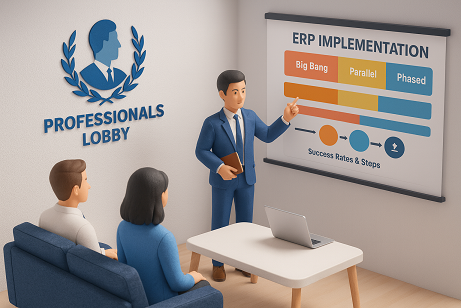
This comprehensive guide explains Big Bang ERP implementation, compares it with other deployment models, provides success rates, and outlines UAE-specific best practices. It also presents how Professionals Lobby uses AI-powered matching and vetted screening to ensure businesses in the UAE connect with the most suitable ERP vendors and consultants.
Quick Navigation
1. What Is Big Bang ERP Implementation?
Big Bang implementation means the entire organization switches from legacy systems to the new ERP all at once, on a single go-live date.
How It Works
- Full system cutover on a chosen implementation day
- All modules (Finance, HR, Inventory, Procurement, Projects, CRM, etc.) are activated simultaneously
- Legacy systems are discontinued immediately
- Success Rate (Global Average): 55%–65% when executed by mature organizations with strong readiness
- Drops significantly for complex, multi-site, or poorly prepared companies
Implementation Example:
A Dubai-based trading company with 100 employees implemented a Big Bang approach during a weekend. They completed data migration on Friday, conducted final testing on Saturday, and went live on Sunday. While challenging, they achieved full operational capability within 72 hours.
Single Go-Live Date
All modules activated simultaneously
2. Other ERP Implementation Methods
While Big Bang is well-known, several other implementation approaches offer different risk profiles and timelines.
Phased (Modular) Implementation
Rollout happens in stages—module by module, department by department, or location by location.
Implementation Approach:
- Start with core modules (Finance, Inventory)
- Add additional modules in subsequent phases
- Common approach for multi-location UAE companies
- Allows for learning and adjustment between phases
Parallel Implementation
Both the legacy system and ERP run together for a period until confidence is high enough to switch fully.
Implementation Approach:
- Both systems operate simultaneously
- Gradual transition as confidence builds
- Ideal for mission-critical operations
- Common in UAE healthcare and financial sectors
Pilot / Proof-of-Concept (PoC) Implementation
ERP is deployed in one department or location, tested, refined, then extended to the entire organization.
Implementation Approach:
- Start with a pilot department or branch
- Identify and resolve issues at small scale
- Refine approach before organization-wide rollout
- Popular for UAE retail chains and multi-branch operations
3. Pros and Cons of Each ERP Implementation Model
Understanding the advantages and disadvantages of each approach helps in selecting the right strategy for your organization.
Pros
- Fastest route to full deployment
- Lower total implementation cost compared to prolonged approaches
- Avoids dual data entry and parallel system maintenance
- Creates immediate integration and standardization
- Forces organizational commitment to the new system
Cons
- Highest risk of operational disruption
- Requires very strong planning and user readiness
- Longer initial downtime if issues appear
- Difficult rollback if failures occur
- Intensive training requirements compressed into short timeframe
Pros
- Lowest risk among all implementation methods
- Issues are easier to isolate and fix
- Reduces employee resistance through gradual adoption
- Works best for multi-site UAE companies (retail, manufacturing, logistics, construction)
- Allows for learning and process refinement between phases
Cons
- Takes longer overall to achieve full implementation
- Temporary data duplication may occur between phases
- Integration between live and non-live modules needs careful management
- Potential for change fatigue over extended implementation period
- Higher total consulting costs due to extended timeline
Pros
- Safest for critical UAE industries (healthcare, finance, aviation, utilities)
- Users can compare old and new outputs in real time
- Smooth transition with minimal operational disruption
- Builds confidence through direct system comparison
- Provides fallback option if new system encounters issues
Cons
- Most expensive due to dual system maintenance
- Heavy workload on teams managing two systems
- Risk of confusion with two systems running simultaneously
- Potential for data inconsistency between systems
- Extended period of reduced productivity due to dual data entry
Pros
- Testing real operations with low organizational risk
- Early identification of localization issues (VAT, WPS, ESR, UAE payroll, multi-currency)
- Practical for multi-branch or diversified groups
- Creates internal champions who can support wider rollout
- Allows for process refinement before full implementation
Cons
- Pilot success does not always reflect full-scale complexity
- Change management must be carefully controlled when scaling up
- Potential for inter-departmental friction if pilot receives preferential treatment
- Extended overall implementation timeline
- Additional costs for pilot-specific configuration
4. Which Model Works Best in the UAE?
UAE businesses have unique characteristics that influence ERP implementation success. Most UAE organizations benefit from a Phased or Pilot approach, especially because of:
Diverse Business Units
Multiple branches and diversified operations across Emirates
Compliance Requirements
Mandatory compliance (VAT, Corporate Tax, ESR, WPS, AML)
Fast-Moving Markets
Limited tolerance for operational downtime in competitive environment
Workforce Dynamics
Multicultural teams requiring strong training and change management
Implementation Recommendations for UAE Businesses
Small to Medium Businesses
Centralized operations with straightforward processes can benefit from Big Bang. Consider Pilot approach for testing UAE-specific compliance features.
Large Enterprises & Multi-Branch
Complex organizations should adopt Phased or Pilot approaches to minimize disruption across multiple locations.
Critical Industries
Healthcare, finance, and utilities should consider Parallel or carefully planned Phased approaches to ensure business continuity.
UAE Implementation Success Story
A leading Dubai retail chain with 25 locations implemented ERP using a hybrid Phased-Pilot approach. They started with a pilot at their flagship store, refined processes for UAE VAT and inventory management, then rolled out to other locations in phases grouped by region. This approach minimized disruption during peak shopping seasons while ensuring compliance from day one.
5. How to Ensure ERP Implementation Success in the UAE
Following a structured approach significantly increases the likelihood of ERP implementation success.
Begin with a Detailed Requirements Study
Cover operational, managerial, financial, and compliance needs specific to UAE operations:
- VAT, Corporate Tax, ESR, WPS compliance requirements
- Multi-company, multi-currency operations
- Localization of HR and payroll for UAE labor law
- Integration needs (POS, CRM, eCommerce, IoT, manufacturing machines)
Select the Right ERP with AI-Driven Matching
Professionals Lobby uses AI, structured questionnaires, and vendor scoring to match businesses with the most suitable ERP vendors and implementers in the UAE.
This avoids the common mistake of choosing based on marketing—or price—rather than capability.
Choose the Right Implementation Model
Do not allow vendors to impose a method. Select based on:
- Business complexity and size
- User readiness and digital maturity
- Compliance sensitivity
- Project timeline and budget constraints
- Organizational risk tolerance
Define Data Migration Rules Early
Clean the data before uploading. UAE companies commonly face issues with:
- Duplicate customer and supplier records
- Outdated inventory records
- Incomplete master data
- Multi-year financial data requiring migration
Establish Strong Governance
Create clear accountability structures:
- Project steering committee with executive sponsorship
- Weekly accountability meetings with defined action items
- Documented UAT (User Acceptance Testing) processes
- Clear RACI matrix for all project activities
- Defined KPIs for each module and phase
Invest in Training and Change Management
Critical in UAE due to multicultural staff. Provide:
- Role-based training sessions
- UAE-specific compliance training (VAT, WPS)
- Mobile app usage for field staff
- Finance month-end process training
- Ongoing support and refresher sessions
Conduct UAT with Real Scenarios
Use real business scenarios during testing:
- Actual invoice processing with UAE VAT calculations
- Purchase order workflows with approval chains
- Payroll processing with WPS requirements
- Inventory cycle counts and adjustments
- Project billing and cost allocation
Post-Go-Live Support
Ensure adequate support after implementation:
- At least 3–6 months of hypercare support
- Dedicated support team for critical issues
- Regular performance reviews and optimization
- User feedback collection and continuous improvement
6. How Professionals Lobby Ensures ERP Success in the UAE
Professionals Lobby acts as an independent ERP advisory, using AI-driven evaluations and vetted screening to match businesses with the right solutions and partners.
Comprehensive Needs Assessment
We conduct detailed analysis of your business processes, compliance requirements, and growth objectives to understand your unique ERP needs.
AI-Powered Vendor Matching
Our proprietary AI algorithm analyzes hundreds of data points to match your requirements with the most suitable ERP systems and implementation partners.
Vetted Partner Screening
We pre-screen all ERP vendors and consultants for UAE experience, technical capability, and successful implementation track records.
Implementation Guidance
We provide ongoing guidance throughout the implementation process, helping you avoid common pitfalls and maximize ROI.
Benefits of Working with Professionals Lobby
Reduced Risk
Our vetting process minimizes implementation risks and vendor mismatches
Faster Implementation
AI matching accelerates vendor selection by up to 70%
Cost Optimization
We ensure you get the right solution at the right price point
UAE Compliance
All recommended solutions include UAE-specific compliance features
Key Takeaways for UAE Businesses
Implementation Strategy
- Big Bang works for small, centralized organizations with high readiness
- Phased approach is safest for most UAE businesses
- Parallel implementation suits mission-critical operations
- Pilot approach ideal for testing before full rollout
Success Factors
- Thorough requirements analysis including UAE compliance
- Strong project governance and executive sponsorship
- Comprehensive data migration planning
- Robust training and change management programs
Professional Guidance
- AI-powered matching improves vendor selection accuracy
- Vetted screening ensures qualified implementation partners
- Independent advisory eliminates vendor bias
- UAE-specific expertise addresses local business needs
Ready to Choose the Right ERP Implementation Approach?
Our ERP experts will help you select the optimal implementation method and connect you with the right partners for your specific business needs.