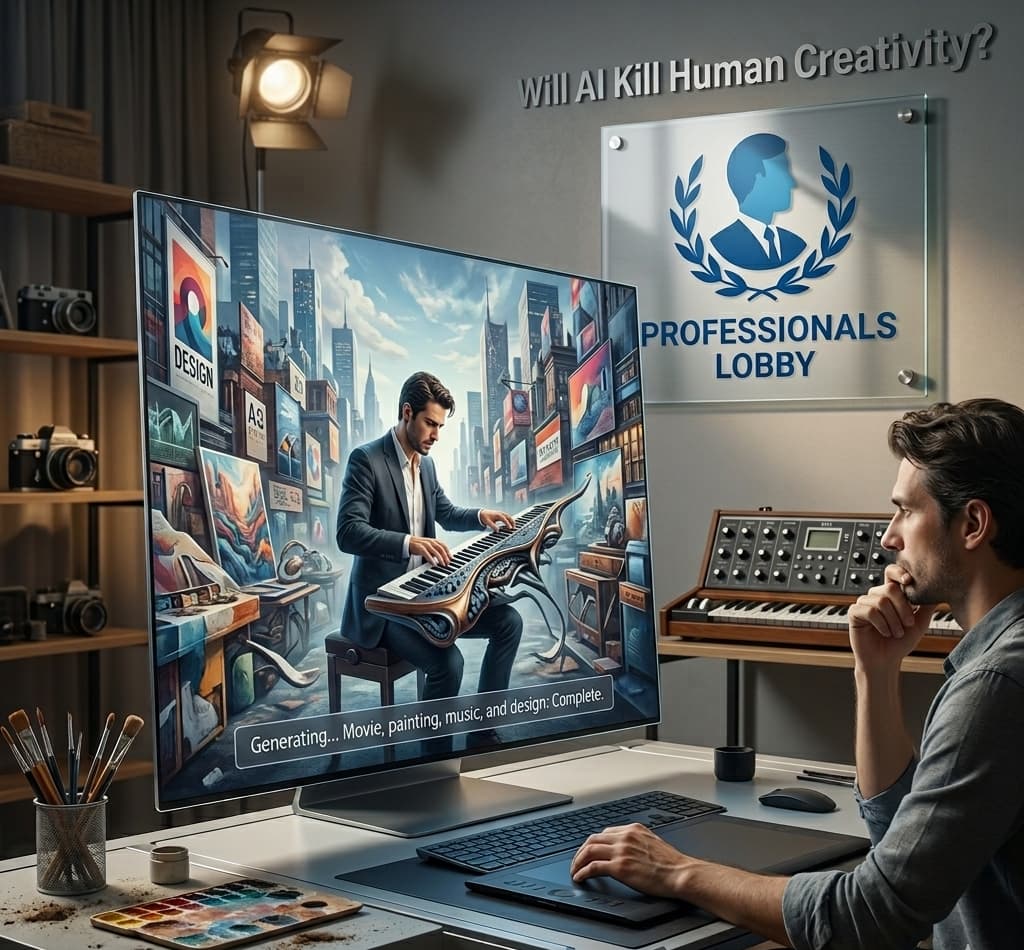
Artificial Intelligence has crossed a critical threshold. What was once assistive is now generative. Today, music can be composed without musicians, paintings created without painters, films generated without cameras, actors, or studios. This raises a fundamental question: If machines can create, what remains uniquely human? This is not just a technological debate — it is an economic, cultural, and philosophical turning point.
Navigate the Debate
The Core Argument: AI Is Not Killing Creativity — It Is Commoditizing It
Let's be precise: AI is not eliminating creativity itself. It is eliminating the scarcity of creation.
This shift transforms creativity from a production skill into a decision-making skill.
The "AI Will Kill Creativity" Argument
This perspective is not entirely wrong — and deserves serious attention.
Skill Atrophy
When AI generates everything, humans stop practicing. Just like calculators reduced mental math ability, generative AI may reduce creative depth.
Homogenization
AI models are trained on existing data. Outputs tend toward averages, not originality. True breakthroughs become rarer.
Loss of Struggle
Creativity is born from constraint, failure, and iteration. AI removes friction — and potentially removes depth and meaning.
Devaluation of Creative Professions
If anyone can generate a logo, song, or video instantly, what happens to designers, musicians, and filmmakers?
The "AI Enhances Creativity" Argument
This side sees AI as the ultimate creative amplifier.
Democratization
Creativity is no longer limited to trained professionals. A teenager with a laptop can now produce what once required a full studio.
Speed of Iteration
Ideas can be tested instantly. Creative cycles shrink from weeks to minutes, enabling rapid experimentation.
New Forms of Expression
AI enables hybrid formats: AI-assisted films, synthetic music genres, interactive storytelling, and immersive experiences.
Focus Shift to Vision
Humans move from execution to ideation. The "what" becomes more important than the "how."
The Real Risk: Not AI — But Passive Creativity
The real danger is not AI itself. The danger is humans becoming passive consumers of machine-generated creativity instead of active creators.
If individuals stop imagining, experimenting, and developing taste — then yes, creativity will decline.
My Position: The Two-Tier Creative Economy
AI will not kill creativity, but it will create a two-tier creative economy:
Tier 1: Mass AI-Generated Content
- Fast
- Cheap
- Abundant
- Often shallow
Tier 2: High-Value Human Creativity
- Deep
- Intentional
- Emotionally resonant
- Scarce → therefore more valuable
True human creativity will become more premium, not obsolete.
The Economic Reality: Creativity Is Being Repriced
This means: A designer is no longer paid for designing. They are paid for knowing what should be designed.
The Hidden Problem: "Creative Illusion"
AI creates a dangerous illusion: People believe they are creative because they can generate outputs.
But generating ≠ creating. True creativity involves:
AI lacks all of these — it only predicts patterns.
Where This Leads: Future Outlook
- Explosion of AI-generated content
- Massive oversupply → reduced value of generic work
- Disruption of entry-level creative roles
- Emergence of "AI-native creators"
- Hybrid roles: AI Director, Prompt Architect, Creative Strategist
- Authentic human creativity becomes a luxury signal
- Audiences increasingly ask: "Was this made by a human?"
Remedies: How to Prevent the Loss of Human Creativity
If society does nothing, creativity will decline in quality — even if output increases.
Redefine Creative Education
Teach idea generation, critical thinking, aesthetic judgment, and storytelling — not just tools.
Promote "AI + Human" Workflows
AI for execution, humans for direction. AI generates 50 designs; humans select, refine, and contextualize.
Build Taste, Not Just Skills
In the AI era, taste becomes the ultimate competitive advantage. Study great works, compare critically, understand why something is good.
Encourage Constraints
Introduce AI-free creative exercises, manual creation challenges, and skill-based practice sessions.
Transparency in Creative Work
Organizations should adopt AI disclosure policies and human-authored content labels.
Reposition Creative Professionals
Designer → Creative Strategist, Writer → Narrative Architect, Musician → Sound Director.
Focus on Meaning, Not Output
AI can generate content but cannot feel, experience, suffer, or aspire. Human creativity must lean into emotion, story, and purpose.
Final Thought
AI is not the end of creativity. It is the end of lazy creativity being valuable.
The future belongs to those who can combine:
If used correctly, AI will not replace creators. It will expose who the real creators are.
Professionals Lobby Insight
In a world where everything can be created instantly, the rarest asset will not be creativity — but meaningful creativity. Our AI consultancy services help businesses navigate this new landscape, balancing technological adoption with human-centric values.