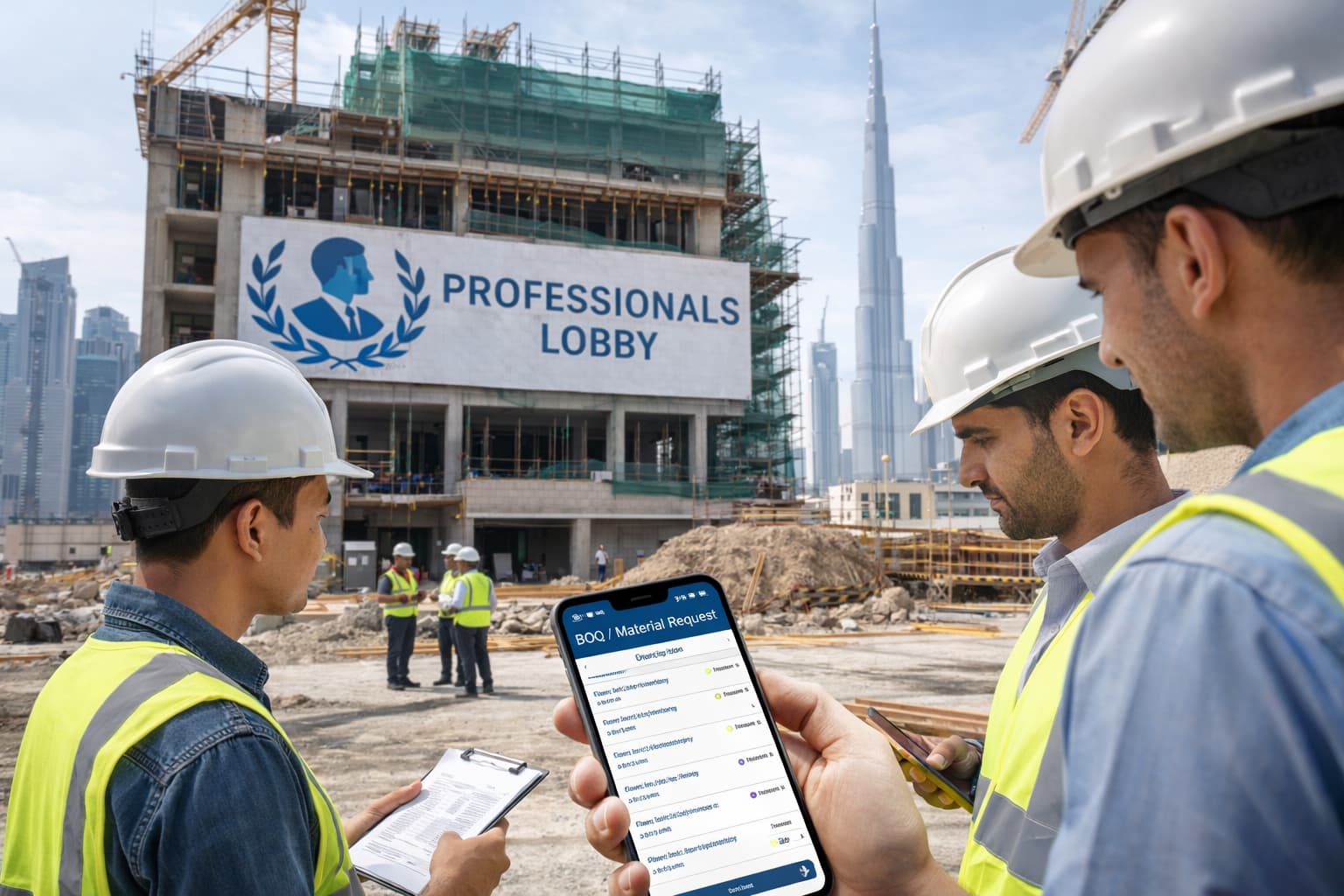
In most construction and project-driven industries, cost overruns are not caused at the end—they are designed at the beginning. Weak estimation structures, disconnected BOQs, and poor material definitions create blind spots that only surface during execution. A well-architected Project Management + ERP framework eliminates this risk by ensuring that every dirham, hour, and quantity is controlled from day one.
1. The Foundation: Broad-Level WBS Estimation
A proper WBS for cost control must include core cost components with quantities and cost logic, not just descriptions.
| WBS Item | Type | Quantity | Unit | Estimated Cost |
|---|---|---|---|---|
| Concrete Works | Material | 500 | m³ | AED 250,000 |
| Steel Reinforcement | Material | 60 | Ton | AED 180,000 |
| Labor (Structural) | Manpower | 3,000 | Hours | AED 90,000 |
| Crane Rental | Machinery | 60 | Days | AED 120,000 |
| Formwork Contract | Subcontract | Lump Sum | — | AED 200,000 |
This level creates: cost visibility, quantity benchmarks, early budget discipline.
2. Transition: Estimation → Tender / Proposal
Once WBS is structured, it converts into a Tender/Proposal with market-aligned pricing and margins. Critical: Internal cost → Client-facing BOQ. Common mistake: disconnected tender BOQs cause no traceability.
3. Post-Award: Converting to Detailed BOQ (Execution Budget)
Convert high-level WBS into a Detailed BOQ. Example transformation:
WBS Item: Concrete Works – 500 m³ → BOQ Breakdown: PCC 50 m³, Footing 150 m³, Slab 200 m³, Column 100 m³. Quantities become granular; cost tracking precise.
4. Material Strategy: Parent-Level vs SKU-Level Definition
Cement, Steel, Aggregate → Used for budgeting and broad control.
Cement OPC 42.5 – Brand A, Steel TMT 16mm – Brand B → Procurement, inventory, quality control.
Best Practice: Maintain dual-level structure: Parent → Budget control; SKU → Execution accuracy.
5. Execution Control: The Real Power
ERP enables hard controls: Quantity Control (cannot issue more than BOQ), Cost Control (procurement linked to budget), Time/Manpower Control (labor hours capped per activity).
| Activity | Budget Qty | Issued Qty | Status |
|---|---|---|---|
| Concrete Slab | 200 m³ | 210 m³ | ❌ Blocked / Approval Required |
Issues detected before escalation—no “surprise overruns” at project closure.
6. Real-Life Scenario Comparison
Traditional Approach
- Estimation in Excel
- BOQ prepared separately
- Materials loosely defined
- ERP used only for accounting
Outcome: Overrun identified at 80–90% completion. No corrective ability.
Structured ERP-Driven Approach
- WBS integrated with ERP
- BOQ derived from estimation
- Materials linked parent → SKU
- Procurement tied to budget
Outcome: Overrun prevented at source. Real-time visibility. Controlled execution.
7. Where ERP Becomes Critical
A robust ERP ensures WBS → BOQ → Procurement → Execution continuity, budget locking, variance tracking, and integrated material management.
8. The Role of Independent Advisory
Most ERP failures happen due to poor structuring, wrong process mapping, and lack of industry alignment. Independent advisory ensures correct WBS design, BOQ mapping strategy, material hierarchy, and implementation governance.
Independent Advisory9. Start Right: Free ERP Assessment & SRS
Before implementing this framework, evaluate current gaps, define structured requirements, prepare SRS aligned to project workflows.
Free ERP Assessment & SRS Preparation10. Knowledge Hub: ERPedia
For deeper insights into ERP concepts, frameworks, and best practices:
ERPedia Knowledge BaseFinal Insight
A project does not fail in execution—it fails in structuring. When WBS, BOQ, and material definitions are aligned within an ERP ecosystem:
- Budget becomes enforceable—not theoretical
- Procurement becomes controlled—not reactive
- Execution becomes predictable—not chaotic
This approach transforms project management from post-facto reporting to real-time control engineering.
Frequently Asked Questions
| Question | Answer |
|---|---|
| How does WBS integrate with BOQ in ERP? | ERP links WBS cost centers to BOQ line items, ensuring every budgeted activity has traceable quantities and cost controls. |
| What is parent vs SKU material definition? | Parent level is for budgeting (e.g., "Cement"). SKU level is for procurement with brand/spec (e.g., "Cement OPC 42.5 – Brand X"). Both coexist in a strong ERP. |
| Can ERP block over-issuance of materials? | Yes, with budget-lock and quantity control features, ERP can prevent issuing materials beyond BOQ quantities without approval workflow. |
| What is the first step to implement this framework? | Start with a Free ERP Assessment & SRS to map your current processes and define structured WBS/BOQ requirements. |