UAE Market Snapshot
The UAE ERP market continues steady growth with projections showing single-digit CAGR through 2028. Cloud computing adoption is accelerating rapidly, with the UAE cloud market expected to reach multi-billion USD by 2025.
Quick Navigation
The AI Revolution in Web-Based ERP
Browser-based ERP systems enable seamless integration with AI agents that can automate complex workflows and dramatically reduce manual effort.
Intelligent Document Processing
AI agents automatically parse invoices, extract data, and post entries without manual intervention
Automated Workflows
Smart routing of approvals, notifications, and exception handling based on business rules
Predictive Analytics
AI-driven insights for inventory optimization, cash flow forecasting, and customer behavior
50% Time Reduction
Automated data entry cuts manual bookkeeping time significantly
99% Accuracy
AI validation reduces human errors in data processing
Real-time Processing
Instant data capture and processing across all locations
Cost Efficiency
Reduced staffing needs for routine administrative tasks
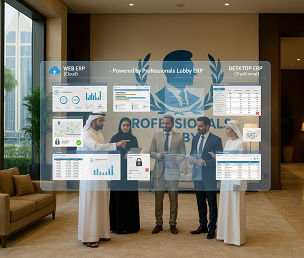
Web vs Desktop ERP: Comprehensive Comparison
Understanding the key differences helps UAE businesses make informed decisions about their technology investments.
| Feature / Criteria | Web (Browser) ERP | Desktop ERP (On-premise) | Advantage |
|---|---|---|---|
| Accessibility | Any device, anywhere via browser | Tied to installed client / machine | Web ERP |
| AI Automation & Integrations | Native support for AI agents, APIs, RPA | Limited, typically custom integrations | Web ERP |
| Updates & Patches | Continuous, vendor-managed | Manual, slower rollout | Web ERP |
| Initial Setup Time | Faster (especially SaaS) | Often longer (on-site installs) | Web ERP |
| Scalability | Elastic (add users/modules) | Scales via hardware upgrades | Web ERP |
| TCO (3-5 years) | Typically lower for most SMEs | Often higher (hardware + maintenance) | Web ERP |
| Data Residency & Compliance | Can choose local cloud or region | Fully under company control (if on-prem) | Situational |
| Offline Use | Limited / hybrid options | Full offline capability | Desktop ERP |
| Security | Centralized controls, frequent patching | Depends on local IT maturity | Web ERP |
Key Takeaway
Web-based ERP systems win in 8 out of 9 critical comparison categories, particularly excelling in accessibility, AI integration, and total cost of ownership - making them the superior choice for most UAE businesses.
Practical Pros & Cons Analysis
Balanced perspective on web-based ERP implementation considerations for UAE businesses.
Advantages of Web ERP
Rapid Deployment & ROI
Faster implementation and quicker return on investment for multi-location businesses
Advanced AI Automation
Reduces bookkeeping time up to 50% through automated workflows and data processing
Seamless Integrations
Easier connections with bank feeds, payment gateways, and UAE e-invoicing systems
Continuous Compliance
Automatic updates for VAT regulations, audit requirements, and government reporting
Local Infrastructure
UAE cloud providers expanding local data centers for better latency and compliance
Considerations & Challenges
Internet Dependency
Requires reliable connectivity (mitigate with offline-capable modules)
Data Governance
Must validate data residency requirements for regulated industries
Vendor Lock-in Risk
Requires careful planning with open APIs and data export capabilities
Custom Integration Complexity
Specialist resources may still be needed for complex on-prem integrations
Where Web ERP Excels: UAE Use Cases
Specific business scenarios where web-based ERP delivers exceptional value in the UAE context.
Multi-Branch Retail
Real-time stock synchronization and POS integration across Dubai/Abu Dhabi stores with AI-driven inventory optimization
Construction & Contracting
Mobile timesheets, site cost control, and project management with real-time budget tracking and AI-powered forecasting
Regional Trading
Instant consolidation, multi-currency management, and automated compliance for companies operating across GCC markets
Professional Services
AI-automated time tracking, expense management, and client billing with intelligent resource allocation
ROI Scenarios
Small Distributor (Dubai)
40% reduction in accounting staff time through automated invoice capture → break-even in 9-14 months
Retail Chain
5-10% sales increase from reduced stockouts and improved forecasting through real-time analytics
UAE Compliance & Regulatory Considerations
Critical compliance factors that make web-based ERP particularly advantageous for UAE businesses.
VAT & E-Invoicing Compliance
Continuous updates ensure compliance with evolving UAE VAT regulations and upcoming e-invoicing mandates
Data Residency Options
Choose between local UAE data centers or regional cloud providers to meet specific regulatory requirements
Government Contracting
Specialized compliance features for businesses working with UAE government entities and regulated sectors
Vendor Selection Guidelines
Web ERP Migration Checklist
Structured approach to successfully transition from desktop to web-based ERP systems.
Process Audit & Data Assessment
Comprehensive review of current workflows, data sources, and integration requirements
- Map existing invoice processing, inventory management, and reporting
- Identify data quality issues and cleanup requirements
- Document integration points with banking and other systems
Module Prioritization
Sequential implementation focusing on highest value areas first
- Start with financial modules (accounts payable/receivable)
- Progress to inventory and supply chain management
- Implement HR and project management modules
- Enable AI automation features progressively
Vendor Selection & Validation
Choose partners with proven UAE experience and capabilities
- Evaluate vendors with local implementation partners
- Verify Arabic interface and UAE VAT compliance
- Test AI automation features with real business scenarios
- Confirm data residency and security protocols
Pilot Implementation
Controlled rollout with measured success criteria
- Start with single business unit or location
- Enable AI automation on lower-risk workflows initially
- Establish clear success metrics and monitoring
- Gather user feedback and make adjustments
Full Deployment & Optimization
Organization-wide rollout with continuous improvement
- Comprehensive user training and change management
- Enable advanced AI features across all modules
- Establish ongoing optimization and enhancement process
- Monitor ROI and business impact metrics
Final Recommendations for UAE Businesses
Prioritize Browser-Based Solutions
Choose web ERP for multi-site operations and faster time-to-value, especially with AI automation capabilities
Make AI Automation a Selection Filter
Evaluate vendors based on invoice OCR, auto-posting, bank reconciliation, and workflow automation capabilities
Choose Local Implementation Partners
Select vendors with UAE partners for implementation, Arabic support, and VAT/e-invoicing expertise
Ready to Modernize Your ERP System?
Professionals Lobby connects UAE businesses with vetted web-based ERP partners featuring AI automation capabilities.