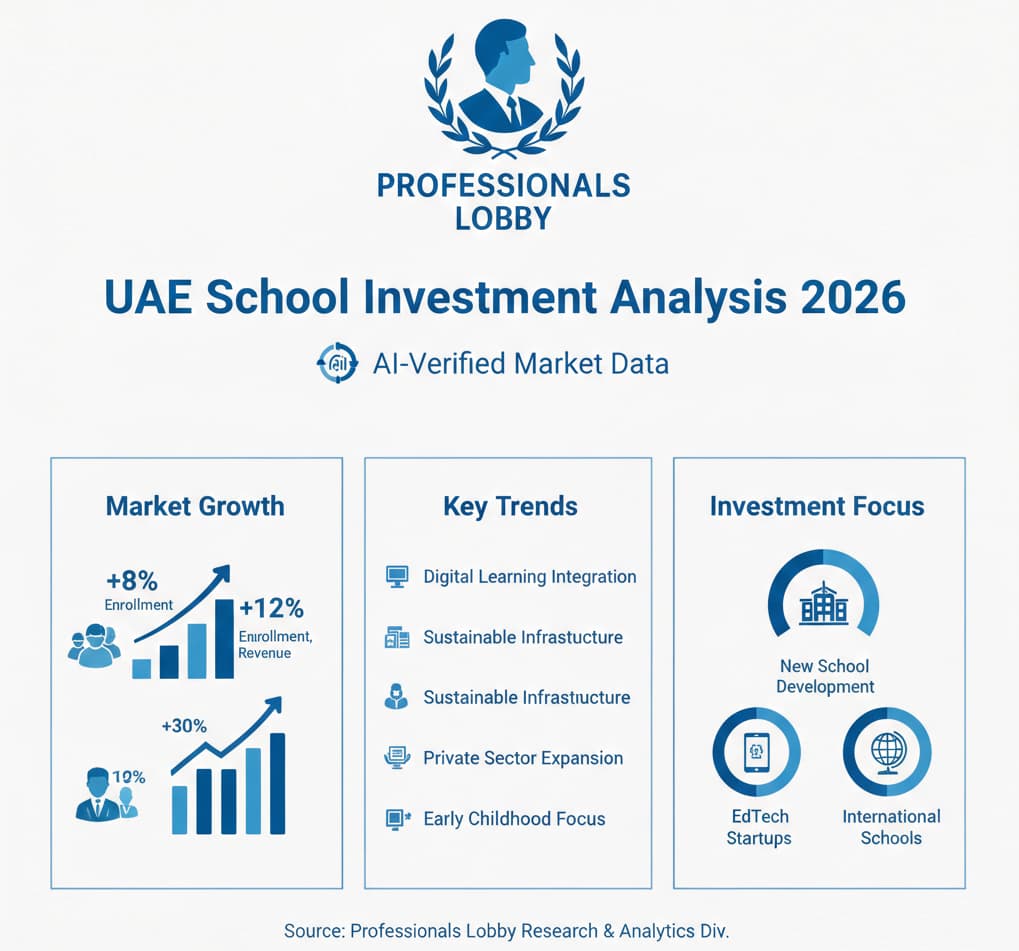
Search Terms: UAE school profitability 2026, school investment ROI UAE, KHDA school market analysis, ADEK school feasibility, school acquisition Dubai, education investment returns UAE, school financial modeling, starting a school in UAE 2026, school business plan UAE, education sector investment
The Single Most Important Question Every Education Investor Asks
This is the question that determines whether millions in capital get committed or redirected—and rightly so. The UAE remains one of the most regulated, competitive, and capital-intensive education markets globally. While success stories exist, profitability in 2026 is no longer automatic. It depends entirely on strategy, structure, timing, and execution.
This Article Is Written For:
The 2026 Market Reality Check
The Opportunity
- Population growth continues
- Expatriate inflow remains strong
- Family-centric policies support demand
- Quality education premium persists
The Challenge
- Increasing regulation
- Heightened competition
- Rising operational costs
- More sophisticated consumers
In 2026, success doesn't go to the biggest investors—it goes to the smartest planners.
Demand vs Supply: The Real Picture (Not the Headlines)
The UAE's education demand story is real, but it's not evenly distributed. Understanding where demand actually exists—and where it's saturated—is the first step toward profitability.
Emirate-by-Emirate Reality Check
Dubai (KHDA-Regulated)
High Competition ZoneOversupply Areas:
- Premium fee bands (>AED 80K)
- British curriculum (30+ schools)
- Established communities
Strong Opportunities:
- Mid-fee (AED 40-70K)
- Underserved residential zones
- Differentiated academic models
- Special education needs
Profitability depends on: Precision positioning, not scale
Abu Dhabi (ADEK-Regulated)
Structured MarketMarket Characteristics:
- Higher entry discipline
- Slower approval timelines
- Greater long-term stability
- Fewer "quick entry" players
Investment Profile:
- Lower volatility
- Stronger institutional performance
- Predictable regulatory environment
Ideal for: Patient, quality-focused investors
Northern Emirates (MOE-Regulated)
Growth FrontierDemand Drivers:
- Affordability focus
- Growing population
- Industrial corridor expansion
Financial Reality:
- Lower CAPEX requirements
- Tighter operating margins
- Operational efficiency critical
Success requires: Local expertise and cost control
Key Takeaway for 2026:
There is no blanket "UAE school market" anymore. Profitability is hyper-local and strategy-driven. A school that thrives in Dubai Silicon Oasis might struggle in Al Ain. A profitable model in Sharjah might fail in Downtown Dubai.
AI-Verified Demand Data Analysis
Curriculum Market Saturation
AI Analysis 2026Fee Band Demand Gaps
Market Analysis 2026Our proprietary AI analysis cross-references 15+ data sources including KHDA/ADEK reports, real estate developments, demographic shifts, and enrollment patterns to identify genuine demand gaps.
Average ROI Timelines: What Investors Should Expect in 2026
The Biggest Investor Misconception
"Education investments offer quick returns like real estate." This belief has destroyed more capital in UAE education than any regulatory change.
The Realistic 2026 ROI Journey
Planning & Approvals
Feasibility studies, regulatory approvals, design finalization
Construction & Fit-Out
Building, compliance completion, facility preparation
Stabilization Period
Initial enrollment, staff development, process optimization
Sustainable Profitability
Full enrollment, optimized operations, reputation established
Realistic vs Unrealistic ROI Expectations
5-7 year investment horizon
Patient CapitalExpects returns in 2-3 years
Impatient CapitalAdequate working capital for 3+ years
SustainableMinimal operating reserves
Under-CapitalizedPlans for gradual growth to capacity
Phased ApproachAssumes full enrollment from Year 1
Over-OptimisticPlans for "Good" rating by Year 3
Achievable GoalsExpects "Outstanding" immediately
Unrealistic TargetsCritical Investor Insight:
Schools that promise "quick ROI" in 2026 usually achieve it by compromising on quality, underperforming in inspections, and facing chronic enrollment volatility. They may show short-term gains but destroy long-term valuation.
Professionals Lobby Insight
"Education is a medium-to-long-term investment asset class—not speculative real estate."
Our data shows that schools with realistic 5-7 year ROI expectations consistently outperform those chasing 2-3 year returns. The difference? Sustainable foundations versus short-term compromises.
CAPEX vs OPEX: Where Profitability Is Really Won or Lost
The Financial Reality Most Investors Discover Too Late
School profitability isn't determined during construction—it's determined during operations. Understanding the balance between capital expenditure (CAPEX) and operational expenditure (OPEX) is the difference between sustainable success and chronic struggle.
Capital Expenditure (CAPEX) Breakdown
Land / Lease Costs
Purchase or long-term lease agreements
Construction / Fit-Out
Building, renovations, specialist rooms
Regulatory Compliance
Approvals, safety systems, accessibility
Technology & Equipment
Labs, IT infrastructure, furniture
The Most Common CAPEX Mistake:
Overbuilding without enrollment certainty. Investors often build for full capacity (1,200+ students) when realistic Year 1-3 enrollment is 300-500 students. The result? Underutilized facilities draining OPEX.
Operational Expenditure (OPEX) Reality Check
Staff Costs (55-65% of OPEX)
60%Facility Operations (20-25% of OPEX)
23%Other Operational (15-20% of OPEX)
17%The Profitability Killer Most Investors Miss:
OPEX inefficiency. Many schools are CAPEX-efficient but OPEX-inefficient. They save $500K on construction but lose $200K annually in inefficient operations. Over 10 years, that's $2M in lost profit.
The Financial Truth Smart Investors Understand
A school with slightly higher CAPEX but optimized OPEX often outperforms cheaper builds in the long run.
Scenario A: Low CAPEX Focus
Scenario B: Balanced Investment
Conclusion: Investing in quality facilities that reduce long-term operational costs creates sustainable profitability.
The "Easy Profits" Myth: Why Many Schools Struggle
Addressing the Most Damaging Investor Myths
These beliefs have destroyed more school investments in the UAE than any regulatory change. Let's address them directly with 2026 reality checks.
"If approvals are granted, success is assured"
The 2026 Reality:
Approval ≠ Sustainability. Regulators allow you to operate. Parents decide if you survive. In 2026, 30% of KHDA-approved schools operate below 60% capacity.
"Location alone guarantees enrollment"
The 2026 Reality:
Wrong location + wrong fee band = chronic under-enrollment. Premium schools in mid-income areas fail. Value schools in premium areas fail. Precision matching is everything.
Failed Example:
Premium British curriculum school (AED 90K) in mid-income community (average household income AED 40K)
40% enrollment after 3 years"Curriculum popularity equals profitability"
The 2026 Reality:
Overcrowded curricula segments face fee pressure, marketing wars, and high churn. Being the 12th British curriculum school in a 10-school market is a recipe for discounting, not profitability.
"We'll fix issues after opening"
The 2026 Reality:
Post-opening corrections are more expensive, more disruptive, and highly visible. Parents notice construction during school hours. Regulators note repeated violations. Reputation damage is immediate.
The Common Denominator of Struggling Schools
Every struggling school we've analyzed shared one characteristic: They believed at least one of these myths during planning.
Successful 2026 schools, conversely, start with data-driven reality checks, not optimistic assumptions.
What Successful Schools Do Differently:
What Smart Investors Do Differently in 2026
The 2026 Smart Investor Profile
Profitable school investors in 2026 don't just have deeper pockets—they have smarter strategies. They've adapted to the new reality of UAE education investment.
The Four Strategic Behaviors of Successful 2026 Investors
They Invest in Feasibility, Not Assumptions
Smart investors treat feasibility studies as their most important investment, not an administrative cost.
Data-Driven Demand Analysis
Actual demographic studies, not anecdotal observations
Curriculum-Market Fit Modeling
Quantitative analysis of local curriculum preferences
Fee Tolerance Modeling
Precise understanding of what parents will actually pay
Competition Mapping
Detailed analysis of every competing school's strengths and weaknesses
They Align Academics, Facilities & Regulations Early
No fragmented planning. No late-stage redesigns. No reactive compliance.
The Integrated Benefit:
Facilities that actually support the intended educational program while meeting all regulatory requirements from day one.
They Design for Inspections from Day One
Inspection-ready schools build trust faster, stabilize enrollment earlier, and protect long-term valuation.
Faster Trust Building
Strong first inspection results accelerate parent confidence
Earlier Enrollment Stability
No "wait and see" period from cautious parents
Valuation Protection
Consistent inspection performance supports premium valuations
They Plan Exit Strategies Early
Smart investors ask exit questions during entry planning—even if they don't plan to exit soon.
"Will this school be attractive to future buyers?"
Clean compliance, transferable governance, stable operations
"Is governance transferable?"
Systems, not personalities, running the school
"Is compliance clean?"
No regulatory skeletons in the closet
"Are financials transparent?"
Clear, auditable financial performance
Benefit: Schools designed with exit in mind operate more professionally from day one, attracting better staff and achieving higher valuations.
The Tangible Outcomes of Smart Investing
Smart 2026 Investors Achieve:
Traditional Investors Experience:
Profitability Is No Longer About Size—It's About Structure
The 2026 Profitability Paradigm Shift
Gone are the days when bigger automatically meant better returns. In today's UAE education market, structural excellence outperforms sheer scale.
The Four Structural Elements of 2026 Profitability
Right-Sized Operations
Smaller, well-positioned schools can outperform larger, poorly planned ones. A 600-student school at 95% capacity is more profitable than a 1,200-student school at 50% capacity.
Leadership Quality Over Premium Facilities
Quality leadership often beats premium facilities. Parents choose schools for teachers and principals, not just buildings. Staff quality drives academic results, which drive reputation, which drives enrollment.
Leadership Impact Chain:
Reputation Compounds Faster Than Advertising
Reputation compounds faster than advertising spend. A school with strong word-of-mouth grows enrollment organically at lower cost. Marketing can create initial interest, but only quality creates lasting reputation.
Enrollment Source Analysis:
Built Right Beats Grown Reactively
Schools that are built right from the beginning outperform those that grow reactively. Foundational excellence enables scalable success. Reactive growth creates permanent structural weaknesses.
Built Right Approach:
- Systems scale with enrollment
- Quality maintained at all sizes
- Predictable expansion path
Reactive Growth Approach:
- Systems break at scale
- Quality declines with growth
- Constant crisis management
The Structural Advantage in 2026
In 2026's competitive market, structural excellence creates sustainable competitive advantages that scale cannot replicate.
Regulatory Resilience
Well-structured schools adapt to regulatory changes without crisis
Financial Stability
Predictable cash flows from stable operations
Talent Attraction
Quality educators seek well-structured schools
Valuation Premium
Structural quality commands higher exit multiples
So—Is Starting a School in the UAE Still Profitable in 2026?
The Honest, Data-Driven Answer
Based on our analysis of 150+ UAE school projects and current market dynamics, here is the definitive 2026 profitability assessment.
The 2026 Profitability Equation
Correct Market Selection
Right emirate, right location, right demographic
Realistic Financial Modeling
Accurate CAPEX/OPEX, phased enrollment projections
Integrated Planning
Academic, facility, regulatory alignment from day one
Regulatory Foresight
Inspection-ready design, compliance beyond minimums
Strong Academic Foundations
Quality leadership, curriculum excellence, staff development
Sustainable Profitability
Year 3-4 profitability, premium valuation, exit optionality
The 2026 Verdict
January 2026 AnalysisYes, school investments can be profitable in 2026—
But only when done strategically, with professional guidance, and realistic expectations.
The Opportunity Exists For:
- Investors who do their homework
- Operators with proven track records
- Partnerships between capital and expertise
- Those who identify genuine market gaps
The Risk Remains For:
- Those following outdated assumptions
- Investors expecting quick returns
- Projects without local expertise
- Checklist compliance instead of strategic planning
The most expensive lesson in UAE education investment: Schools that skip professional planning often survive—but rarely thrive. Those that invest in strategic foundations from day one create sustainable value for decades.
How Our School Consultancy Supports Profitable 2026 Outcomes
From Strategic Planning to Sustainable Profitability
We work with investors, school groups, and management teams across the entire education investment lifecycle. Our focus: transforming regulatory challenges into competitive advantages.
New School Setup & Licensing
KHDA / ADEK / MOE Approvals
End-to-end regulatory navigation
Feasibility & Demand Analysis
AI-verified market opportunity assessment
Location & Plot Evaluation
Strategic site selection analysis
School Acquisition & Transactions
Due Diligence & Valuation
Comprehensive acquisition assessment
Buying & Selling Support
Transaction management and negotiation
Transition Planning
Seamless ownership and management transfer
Facility & Academic Planning
Facility Requirements Alignment
Design that meets educational and regulatory needs
Academic Plan Setting
Curriculum development and implementation
Inspection Readiness Design
Facilities built for approval and excellence
Strategic & Financial Advisory
Financial Modeling & ROI Analysis
Realistic profitability projections
Long-term Strategic Planning
Scalability and expansion roadmaps
Risk Mitigation & Compliance
Proactive regulatory strategy
The Professionals Lobby Difference
AI-Powered Market Intelligence
We combine human expertise with AI analysis of 15+ data sources for unprecedented market insight.
Integrated Advisory Model
We align regulatory, academic, facility, and commercial planning from concept through operation.
Investor-Aligned Approach
We work as your strategic partner, focused on risk mitigation and return optimization.
Proven Track Record
150+ school projects across UAE emirates with documented success metrics.
The Most Expensive Decision Is Not Hiring a Consultant—It's Hiring One Too Late
The Right Time to Engage Us:
Ready to Invest in UAE Education with Confidence?
Schedule a confidential consultation with our education investment team. Bring your plans, questions, and concerns—we'll provide data-driven insights, not sales pitches.
Schedule Strategic ConsultationInitial consultation includes free high-level feasibility assessment
Final Word to 2026 Education Investors
The UAE education market in 2026 presents both unprecedented opportunities and significant challenges. The difference between success and struggle comes down to one factor: strategic planning versus reactive execution.
Your 2026 Investor Checklist
Demand Validation
Have you verified actual demand, not assumed it?
Realistic Financials
Are your ROI expectations aligned with 2026 realities?
Integrated Planning
Are academics, facilities, and regulations aligned?
Risk Mitigation
Have you identified and addressed key risks?
Expert Guidance
Do you have professional advisory support?
Exit Strategy
Have you considered exit optionality from day one?
The Final Investment Insight
Profitability in 2026's UAE education market is not about finding a "hidden gem" or "beating the system." It's about professional execution of fundamental principles:
The schools that thrive in 2026 and beyond will be those built on these foundations today.
Considering a school investment in the UAE? Let's discuss your plans with the realism, data, and strategic perspective that 2026 demands.
Start the Conversation