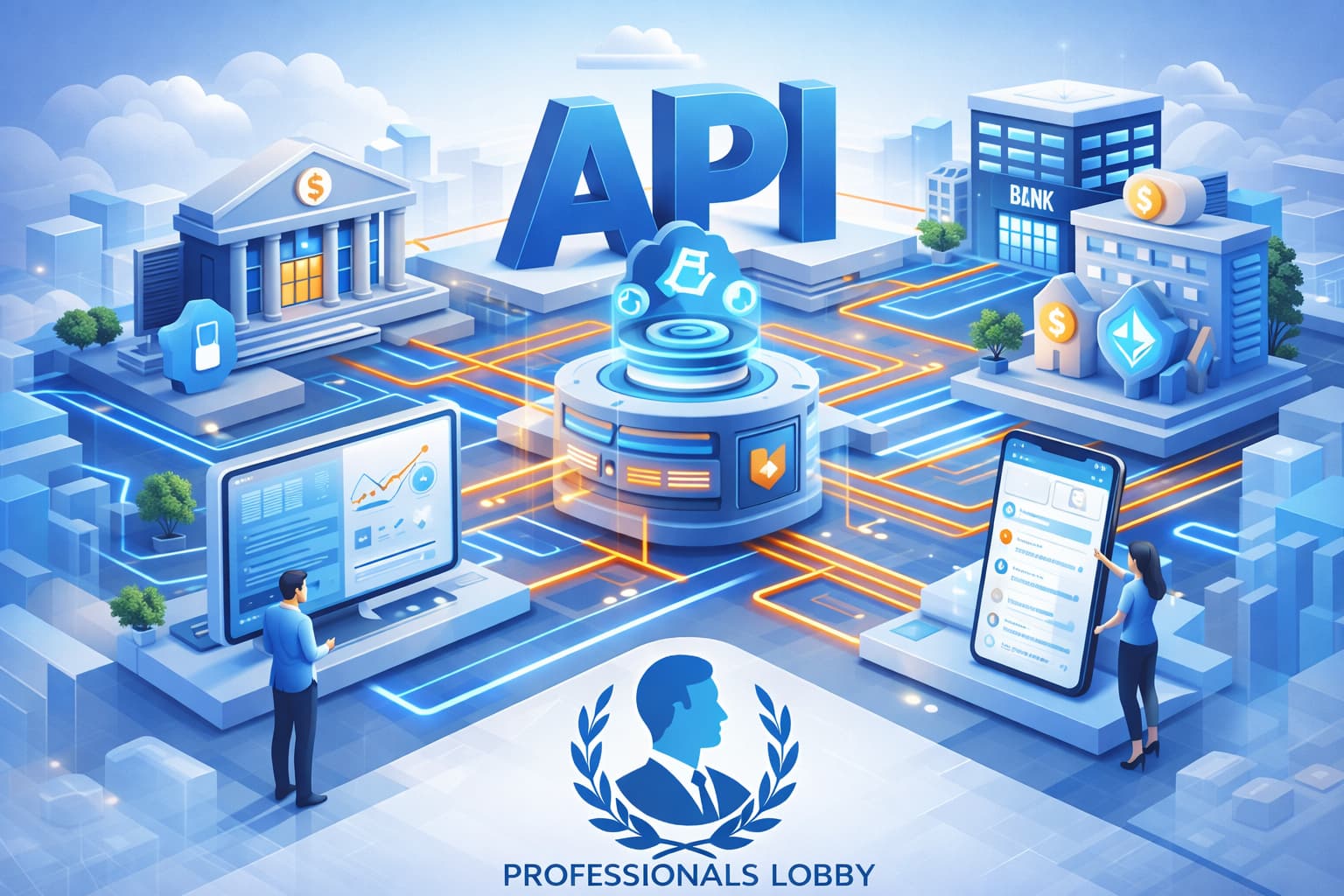
In today's interconnected digital landscape, the ability for software to communicate seamlessly is not just an advantage—it's a necessity. At the heart of this communication lies the Application Programming Interface, or API. From the banking app on your phone to the complex ERP systems powering major UAE corporations, APIs are the silent enablers of modern business. This comprehensive guide from Professionals Lobby will demystify APIs, exploring their history, architecture, security, and their critical role in enterprise software and the future of business technology.
Quick Navigation
1. What is an API?
An API (Application Programming Interface) is a structured set of rules, protocols, and definitions that enables different software systems to communicate with each other. Think of it as a bridge or intermediary that allows one application to request data or services from another without needing to understand its internal workings.
Real-world analogy: The Restaurant Experience
- You (Client): Place an order (Request).
- Waiter (API): Takes your order to the kitchen and brings back the food.
- Kitchen (Server): Processes the order and prepares the food (Data/Service).
You don't need to know how the kitchen works; the waiter (API) handles the communication.
2. Why APIs Are Critical in Modern Web Architecture
Modern applications are no longer monolithic. They are built using microservices, cloud-native architectures, and third-party integrations. APIs are the glue that holds these complex systems together.
Without APIs:
Systems become tightly coupled, scaling becomes difficult, and integration becomes an expensive, slow process.
3. Importance of APIs in ERP and Enterprise Software
ERP systems like SAP, Oracle NetSuite, Microsoft Dynamics 365, and Odoo rely heavily on APIs to function as the central hub for business operations.
Payment Gateway Integration
APIs connect your ERP to banks and payment processors for real-time reconciliation.
E-commerce Synchronization
Keep inventory, orders, and customer data in sync between your online store and ERP.
Logistics & Tracking
Integrate with shipping carriers to get real-time shipment tracking and automate logistics.
Automation
Trigger workflows like invoice generation or tax calculations automatically.
Ready to integrate APIs into your ERP for seamless operations? Talk to our ERP Consultants or explore the top ERP solutions in the UAE.
4. Real-World Example: Banking & Utility App Integration
A mobile banking app uses a network of APIs to provide a seamless experience for its users. This is a perfect illustration of the API economy.
Result: A seamless, real-time experience that would be impossible without APIs.
5. History of APIs and the Evolution of Integration
6. Types of APIs
Available to external developers (e.g., Google Maps API).
Shared with specific business partners with controlled access.
Used within an organization for internal systems.
Combine multiple service calls into a single request for efficiency.
7. What is REST API? & The Structure of an API
REST (Representational State Transfer) is the most common architectural style for APIs today. It uses standard HTTP methods and is stateless, making it lightweight and scalable.
Example: A REST API Request
GET /api/customers/123 HTTP/1.1
Host: api.example.com
Authorization: Bearer YOUR_TOKEN
Example JSON Response
{
  "id": 123,
  "name": "ABC Trading LLC",
  "balance": 5000,
  "vat_number": "123456789"
}
A typical API consists of an Endpoint (URL), a Request (method, headers, body), and a Response (status code, data).
What is Open API (Swagger)?
The OpenAPI Specification (formerly Swagger) is a standard, language-agnostic interface description for REST APIs. It allows both humans and computers to understand the capabilities of a service without access to source code, enabling automated documentation and client code generation.
8. API Security: How Data is Protected
With APIs becoming primary targets for attackers, security is paramount. Modern APIs implement a multi-layered security strategy.
Encrypts data in transit.
API Keys, OAuth 2.0, JWT tokens.
Controls what authenticated users can do.
Prevents abuse and DDoS attacks.
Prevents injection attacks.
Centralized control and anomaly detection.
9. Key Advantages of APIs
- Faster Development: Leverage existing services instead of building from scratch.
- Scalability: Scale individual components independently.
- Reusability: Build once, use across multiple applications.
- Real-time Data Exchange: Enable instant updates and synchronization.
- Ecosystem Integration: Connect your business to a wider partner network.
- Improved User Experience: Create seamless, integrated customer journeys.
10. Alternatives to APIs (and Why APIs Win)
Verdict: While alternatives exist for specific use cases, APIs provide the most robust, secure, and scalable solution for modern software integration.
Conclusion: APIs as Business Enablers
APIs are the backbone of modern digital infrastructure. From ERP systems to banking apps and AI platforms, they enable seamless communication, automation, and scalability. For organizations in the UAE and globally, adopting an API-first mindset is no longer optional—it's essential for competitiveness, efficiency, and future growth.
Professionals Lobby Insight
At Professionals Lobby, APIs are integral to our services. They help us:
- Connect businesses with the right ERP, AI, and IT service providers.
- Enable AI-driven recommendations and insights.
- Integrate a diverse ecosystem of consulting, legal, tax, and technology partners.
APIs are not just integrations—they are the foundation of intelligent business networks.
Ready to Leverage APIs for Your Business?
Whether you're selecting a new ERP or need expert advice on software integration, our independent advisors can guide you.