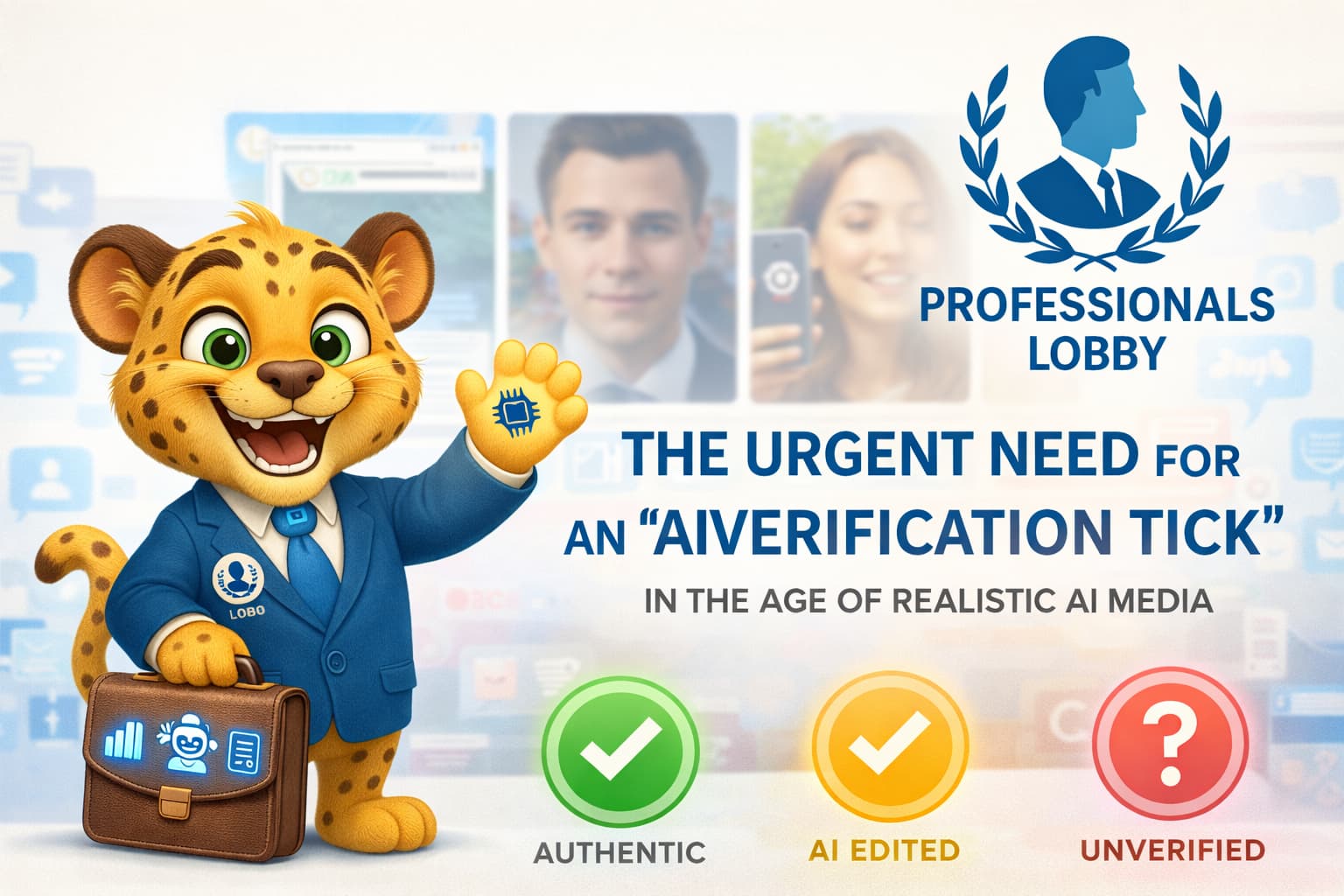
Search Terms: AI verification tick, digital trust system, AI media detection, WhatsApp misinformation, AI content provenance, social media verification, UAE technology ethics, Professionals Lobby AI insights, synthetic media verification, digital authenticity
The Trust Crisis: When Seeing Is No Longer Believing
Artificial intelligence has achieved what was once considered science fiction: generating photos, videos, and audio that are virtually indistinguishable from real content. What once required advanced studios and specialists can now be created in minutes by anyone with access to AI tools.
The Fundamental Question Has Changed
It is no longer "Is this content viral?" but "Can this content be trusted?"
The Real Problem: AI-Altered Media Is Harder Than Fake Media
Contrary to popular belief, fully AI-generated content is easier to detect than partially altered media:
Real Videos with AI-Modified Faces
Authentic footage with faces swapped or expressions altered
Genuine Audio with AI Voice Enhancement
Real recordings with words changed or tone manipulated
Authentic Photos with AI-Altered Context
Real images with backgrounds, expressions, or details modified
Why These Hybrid Forms Are Dangerous:
- Extremely difficult to detect with current technology
- Easily mistaken for authentic content and shared widely
- Often forwarded without malicious intent by ordinary users
- Current AI detection tools frequently fail with hybrid content
The Detection Fallacy: Why AI Detection Alone Will Never Be Enough
There's a growing misconception that better AI detectors will solve the problem. This approach has fundamental structural limitations that make it insufficient for the current challenge.
AI Creation Tools Evolve Faster
New generation models are released monthly, while detection tools take much longer to develop and deploy.
Minor Changes Break Detection
Simple modifications like resizing, adding noise, or screen recording can bypass most detectors.
Human-AI Collaboration Leaves No Footprint
When humans edit AI-generated content, it creates unique patterns that detection systems can't categorize.
Platforms Strip Metadata
Social media and messaging apps remove critical provenance data during upload and sharing.
Professionals Lobby Critical Insight
"Detection after posting is a losing game." The cat-and-mouse chase between creation and detection creates an endless cycle where trust continues to erode while technology advances.
We must shift from reactive detection to proactive verification.
The Paradigm Shift: From Detection to Verification
Current Approach: Detection
- Reactive: Analyzes content after distribution
- Question: "Is this AI-generated?"
- Focus: Policing and flagging
- Limitation: Always one step behind
Proposed Approach: Verification
- Proactive: Establishes trust at creation
- Question: "Is this media verified, and what is its origin?"
- Focus: Provenance and transparency
- Advantage: Trust travels with content
The AI Verification Tick System: A Practical Solution
The AI Verification Tick is not merely a technical feature — it's a social necessity. It acts as a trust indicator, not a judgment tool, providing context and transparency without labeling content as "good" or "bad".
Core Principle: Provenance Over Policing
The system doesn't ask "Is this AI-generated?" but rather "Where did this media come from, and was it altered?"
Proposed Verification Levels
🟢 Verified Authentic
Green Tick- Captured using a real device (camera, recorder)
- No AI manipulation or only basic edits (cropping, brightness)
- Cryptographic signature and metadata intact
- Content matches its claimed origin
🟡 AI-Assisted / Edited
Yellow Tick- AI used for enhancement or modification
- Alterations are disclosed and documented
- Content remains non-deceptive
- Creative use acknowledged as AI-assisted
🔴 Unverified / Trust Unknown
No Tick- Metadata removed or broken
- Re-recorded, forwarded, or screen-captured
- Authenticity cannot be established
- Requires independent verification
Critical Distinction: Lack of a tick does NOT mean "fake"
It means "trust cannot be confirmed". This distinction is essential for fairness and preventing misuse of the system.
How It Works in Practice
Content Creation
Camera app embeds cryptographic signature with metadata including device ID, timestamp, and location hash.
AI Editing
If AI tools are used, they append to the metadata chain, recording what was modified and with which model.
Platform Display
Social media platforms read the verification data and display appropriate tick with transparency details on tap.
Forwarding Protection
When content is forwarded, platforms check if verification chain is intact or downgrade trust level accordingly.
The Messaging Platform Battlefield: WhatsApp, Telegram & Social Media
Private messaging platforms present the most significant challenge for digital trust, as they are designed for privacy and speed at the expense of transparency.
Metadata Destruction
Platforms like WhatsApp and Telegram strip metadata by default to save bandwidth and storage.
Context-Free Forwarding
Content is forwarded without its original context or verification chain.
Emotional Amplification
Private messages carry more emotional weight and are trusted more than public content.
Encryption Trade-offs
End-to-end encryption protects privacy but also hides content origins and modifications.
The Forwarding Solution: Smart Trust Degradation
Similar to "Forwarded many times" warnings — but smarter and more meaningful.
When content loses its verification chain through forwarding, platforms should:
- Automatically downgrade the verification status
- Show clear visual indicators of trust degradation
- Provide options to request original verification
- Educate users about trust implications of forwarding
Platform Responsibility Framework
Technical Responsibility
Preserve verification metadata through forwarding chains
User Interface Responsibility
Display trust indicators clearly and intuitively
Educational Responsibility
Teach users about digital provenance and trust signals
Ethical Responsibility
Balance privacy with transparency appropriately
The Uncomfortable Truth: Why Even AI Cannot Always Detect AI
As an AI System, This Must Be Stated Clearly
AI does not understand "truth" — it recognizes patterns. When human creativity blends with AI capabilities, detection becomes fundamentally unreliable.
Why Detection Fails with Hybrid Content
No Definitive Signal
Human-AI hybrid content contains mixed patterns that don't fit clean detection categories.
Realism ≠ Authenticity
Perfect visual or audio realism no longer proves content is authentic.
Misplaced Confidence
Detection tools often provide confidence scores that users misinterpret as certainty.
Adversarial Training
AI creation tools can be specifically trained to bypass detection systems.
The Ethical Responsibility of AI Technology
"AI should not become a perfect impersonator without accountability."
Clear Disclosure
AI systems should declare their involvement in content creation or modification.
Embedded Origin Markers
Creation tools should embed non-removable provenance data at the source.
Platform Transparency
Social platforms should make trust indicators visible, not hidden in menus.
Public Education
Users must understand that "Realistic ≠ Real" in the AI age.
AI must remain a tool that empowers society, not one that silently undermines trust.
The 100% Detection Myth
Any system claiming perfect accuracy in AI content detection is misleading users. The mathematics of pattern recognition combined with human creativity makes 100% detection theoretically impossible.
The Future of Digital Trust: What Comes Next
Within 2-3 Years: The End of "Seeing Is Believing"
The phrase "seeing is believing" will become obsolete. Instead, we will develop new frameworks for digital trust.
Legal Recognition
Courts and governments will require digital provenance for evidence and official communications.
Journalism Standards
News organizations will adopt verification requirements for all visual and audio content.
Economic Value Shift
Verified content will become more valuable than viral content in professional contexts.
Educational Integration
Digital literacy curricula will include verification skills as fundamental as reading.
The Evolution of Our Fundamental Questions
The Verification Ecosystem of Tomorrow
The AI Verification Tick requires collaboration across the entire digital ecosystem. No single entity can solve this challenge alone.
The Professionals Lobby Perspective
The AI Verification Tick is not merely a technical feature — it is social protection. Without it, we risk entering an era where trust becomes impossible to establish, and emotional manipulation becomes trivial.
Our Core Belief
At Professionals Lobby, we believe that technology should enhance human connection, not undermine it. The AI Verification Tick represents this principle in practice:
AI must empower society with visible fingerprints, not deceive it with perfect impersonation.
Those who implement verification systems today will define the standards of digital trust tomorrow.
"The future of digital media depends not on stopping AI, but on making trust visible."
A Question for Reflection
As we stand at this historical threshold of digital authenticity, ask yourself:
Your answer determines whether you're consuming the past or participating in the future of digital trust.
The Final Frame: Trust Made Visible
In this new era of synthetic media, you are no longer a passive consumer of potentially manipulated content.
You can become an active participant in a transparent digital ecosystem.
The verification tick makes trust a visible choice.